
How Much Does Pet Insurance Cost in 2026?
If you want to know if pet insurance is worth the money right now, seeing the actual price is a great first step.
This clarifies typical monthly rates, what really changes the cost, and how to figure out if the expense is a good idea for your own life.
Key Highlights
- Average monthly cost is $62.44 for dogs and $32.21 for cats.
- Prices vary by breed, age, location, and coverage.
- High-risk dogs in big cities can reach ~$120/month.
Average Pet Insurance Cost
The most widely cited industry data comes from NAPHIA, which reports an average pet insurance cost of about $62 per month for dogs and $32 per month for cats on accident and illness plans.
Accident only plans are cheaper like $16.10/month for dogs and $9.17/month for cats.
Pawlicy Advisor data for 2026 shows dog premiums spanning $37.18 to $72.99 per month and cat premiums from $23.84 to $49.76, depending on how you configure your plan.
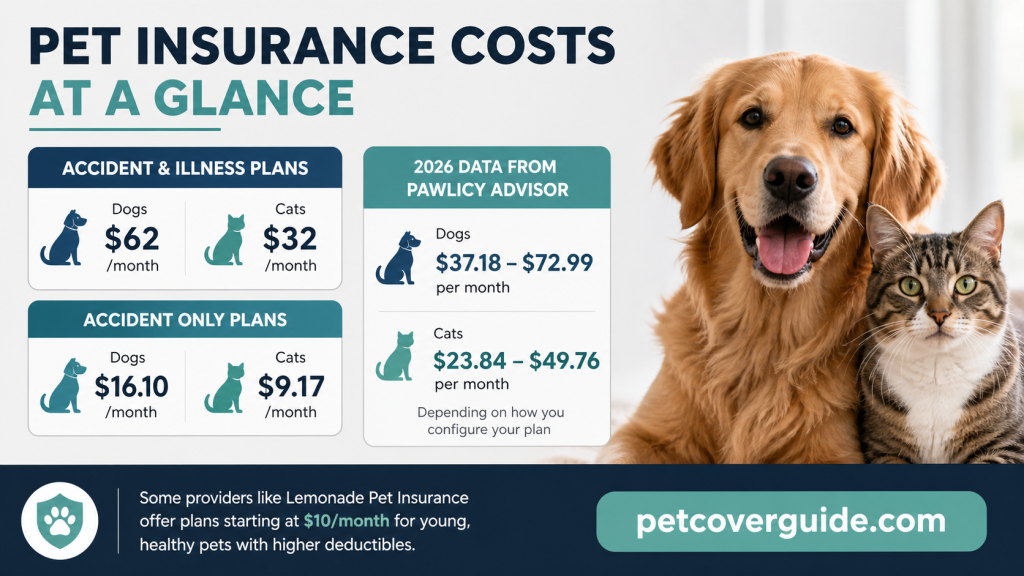
And providers like Lemonade Pet Insurance advertise policies starting at $10/month, though that entry-level pricing typically reflects young, healthy pets with higher deductibles.
Pet Insurance for Dogs
The pet insurance cost for dogs averages $62.44/month for comprehensive accident and illness coverage.
That’s the plan type most veterinarians and insurance advisors recommend, since it covers everything from broken bones to cancer to chronic conditions like diabetes.
Depending on breed, age, location, and plan setup, your dog insurance monthly premium could range from $37 to $73 per month.
Accident-only dog plans average $16.10/month, but they only pay out for injuries like fractures or lacerations.
➤ They won’t cover illnesses, which account for the majority of expensive vet bills.
Pet Insurance for Cats
The pet insurance cost for cats is significantly lower.
The average cat insurance monthly premium sits at $32.21/month for an accident and illness plan. Domestic shorthairs and mixed breeds tend to fall at the lower end of the $23.84 to $49.76 range.
Accident-only cat plans average just $9.17/month, making them among the most affordable pet insurance options available.
If you’re on a tight budget and just want coverage for emergencies like poisoning or trauma, that’s a reasonable starting point.
Pet Insurance Cost by Coverage Tier
Pet insurance breaks down into three main tiers, each with a different price range and scope of protection.
| Coverage Tier | Monthly Cost Range |
|---|---|
| Basic (Accident-Only) | $10–$20/month |
| Standard (Accident & Illness) | $35–$75/month |
| Comprehensive (with Wellness Add-On) | $50–$100+/month |
Wellness and preventive care add-ons typically cost an additional $10 to $30/month on top of your accident and illness premium.
That’s a modest savings of $60 to $210 annually. The real benefit is spreading those costs into predictable monthly payments rather than facing lump-sum vet bills.
Pet Insurance Cost by Breed
Breed is one of the biggest pricing factors. Insurers use actuarial data on breed-specific health risks to set premiums.
➤ Brachycephalic breeds like French Bulldogs and Pugs have higher rates of respiratory issues, spinal problems, and skin conditions.
➤ Giant breeds like Great Danes face elevated risks of bloat, heart disease, and joint problems. Cancer-prone breeds like Golden Retrievers also pay more.
➤ Mixed-breed dogs, on the other hand, benefit from genetic diversity and tend to have fewer hereditary conditions.
That translates directly into lower premiums, often $35 to $55/month compared to $80 to $120+ for high-risk purebreds.
Average Monthly Premiums
The following estimates reflect a 1- to 2-year-old dog with a $500 annual deductible, 80% reimbursement, and $5,000 to unlimited annual maximum.
Large breed dog insurance cost tends to be 30 to 60% higher than small breeds due to more expensive veterinary procedures.
| Dog Breed | Average Monthly Premium |
|---|---|
| Mixed Breed (Medium) | $35–$55 |
| Chihuahua | $28–$42 |
| Yorkshire Terrier | $32–$48 |
| Beagle | $40–$58 |
| Dachshund | $38–$55 |
| Poodle (Standard) | $45–$65 |
| Labrador Retriever | $48–$70 |
| Golden Retriever | $55–$80 |
| German Shepherd | $52–$78 |
| Siberian Husky | $45–$68 |
| Boxer | $58–$85 |
| Rottweiler | $60–$90 |
| Bulldog (English) | $75–$110 |
| French Bulldog | $80–$120 |
| Great Dane | $85–$125 |
Average Monthly Premiums for Cat
Cat insurance pricing shows less dramatic variation than dogs, but breed still matters.
Abyssinian cats typically fall in the mid-range at $28 to $40/month due to hereditary risks like renal amyloidosis.
| Cat Breed | Average Monthly Premium |
|---|---|
| Domestic Shorthair | $20–$30 |
| Mixed Breed | $20–$30 |
| Siamese | $25–$38 |
| Abyssinian | $28–$40 |
| British Shorthair | $28–$42 |
| Ragdoll | $30–$45 |
| Maine Coon | $32–$48 |
| Persian | $35–$50 |
| Bengal | $38–$52 |
Costs Change by Age
Age is the other major cost driver. Premiums climb steadily as your pet gets older, reflecting the increasing likelihood of illness and injury.

Here’s how pricing typically progresses for a medium mixed-breed dog on a standard accident and illness plan:
Cost Change by Age
A 1-year-old Labrador Retriever might pay $45/month.That same dog at age 8 could cost $95 to $120/month, and by then, any conditions that developed are excluded as pre-existing.
| Age | Estimated Monthly Premium (Dog) | Estimated Monthly Premium (Cat) |
|---|---|---|
| 1 year | $30–$40 | $20–$25 |
| 3 years | $38–$50 | $25–$32 |
| 5 years | $45–$60 | $30–$38 |
| 8 years | $75–$100 | $45–$60 |
| 10 years | $95–$130 | $55–$75 |
| 11+ years (dog) / 13+ years (cat) | $110–$150+ | $70–$90 |
Senior pet insurance premiums can escalate by 10 to 20% or more per year.
This is exactly why enrollment timing matters so much. Every year you wait, you pay more and risk accumulating conditions that no insurer will cover.
Expected Annual Premium Increases
Your pet insurance premium is not locked in.
Most policyholders see 8 to 15% annual increases, driven by three factors:
- your pet aging into higher risk categories
- veterinary cost inflation running at roughly 5 to 8% annually
- regional rate adjustments
Let me show you how it looks like over time for a dog enrolled at age 1 with a $45/month starting premium, assuming a 10% average annual increase:
| Year | Pet’s Age | Estimated Monthly Premium |
|---|---|---|
| Year 1 | 1 | $45 |
| Year 3 | 3 | $54 |
| Year 5 | 5 | $66 |
| Year 7 | 7 | $80 |
| Year 10 | 10 | $106 |
Some providers like Trupanion claim more stable pricing models. It’s worth reviewing your policy every two to three years and comparing quotes.
Just be cautious: switching insurers means any conditions your pet developed under the old policy become pre-existing and won’t be covered by the new one.
Pet Insurance Cost by State
Veterinary care costs more in urban and coastal areas.
State insurance regulations vary. Even regional disease prevalence plays a role; tick-borne illnesses are more common in the Northeast, while valley fever affects pets in the Southwest.
New York City consistently trends toward the top of pet insurance pricing ranges. Rural areas in the Midwest and South tend to be the most affordable.
| State | Average Dog Premium (Monthly) | Average Cat Premium (Monthly) |
|---|---|---|
| New York | $60–$90 | $35–$55 |
| Connecticut | $60–$86 | $34–$52 |
| California | $56–$81 | $32–$50 |
| Massachusetts | $55–$80 | $32–$48 |
| New Jersey | $55–$78 | $31–$47 |
| Washington | $50–$72 | $29–$45 |
| Colorado | $48–$68 | $28–$43 |
| Illinois | $47–$66 | $27–$42 |
| Pennsylvania | $46–$65 | $27–$41 |
| Florida | $46–$61 | $26–$40 |
| Oregon | $45–$64 | $26–$40 |
| Virginia | $44–$60 | $25–$39 |
| Texas | $42–$58 | $24–$38 |
| North Carolina | $41–$56 | $24–$37 |
| Ohio | $40–$55 | $23–$36 |
| Georgia | $40–$54 | $23–$36 |
| Michigan | $40–$55 | $23–$36 |
| Indiana | $38–$52 | $22–$34 |
| Iowa | $36–$50 | $21–$33 |
| Idaho | $35–$48 | $20–$32 |
Top Pet Insurance Providers
A pet insurance comparison across major providers reveals significant differences in pricing, plan flexibility, and claims experience.
| Provider | Starting Monthly Cost | Reimbursement Options | Annual Max Options | Waiting Period |
|---|---|---|---|---|
| Lemonade | $10/month | 70%, 80%, 90% | $5K–$100K | 2 days (accidents), 14 days (illness) |
| Healthy Paws | $15/month | 70%, 80%, 90% | Unlimited only | 15 days |
| Embrace | $13/month | 70%, 80%, 90% | $5K–$30K | 2 days (accidents), 14 days (illness) |
| Trupanion | $25/month | 90% only | Unlimited only | 5 days (accidents), 30 days (illness) |
| Spot | $11/month | 70%, 80%, 90% | $2.5K–Unlimited | 2 days (accidents), 14 days (illness) |
| ASPCA | $12/month | 70%, 80%, 90% | $5K–Unlimited | 14 days |
| Nationwide | $13/month | 70%, 90% | Varies by plan | 14 days |
| Pumpkin | $20/month | 90% only | $10K–Unlimited | 14 days |
| Progressive (Pets Best) | $14/month | 70%, 80%, 90% | $5K–Unlimited | 3 days (accidents), 14 days (illness) |
Keep in mind that these starting prices reflect the lowest cost configurations. Your actual quote will depend on your specific pet.
Tools like Pawlicy Advisor let you compare personalized quotes from multiple providers side by side, which is the fastest way to find the best value for your situation.
Deductibles, Reimbursement Levels, and Coverage Limits
Three levers control both your premium and your out-of-pocket costs: your deductible, reimbursement percentage, and annual maximum.
Three factors affect cost, including deductible, reimbursement, and annual limit. Deductible ranges 100 to 1000 dollars.
A higher deductible lowers premiums but increases the upfront cost. Reimbursement ranges 70 to 90 percent.
Higher coverage means higher premium. Annual limits range from 5000 to unlimited.
Lower limits reduce cost but cap payouts.
Example 4500 dollar surgery with 500 deductible and 80 percent reimbursement leaves you paying 1300 dollars
• Waiting periods are usually 2 to 14 days for accidents and 14 to 30 days for illness
These settings together decide how much you pay monthly and at claim time
A Cost Comparison
Some pet owners consider “self-insuring” by setting aside $50 to $75 per month in a dedicated savings account.
That approach has one major flaw: a $5,000 emergency in year one wipes out your fund before you’ve saved enough.
Let’s have a look at how it actually compares to cost.
| Procedure | Average Cost (No Insurance) |
|---|---|
| Routine annual exam | $50–$75 |
| Vaccinations (annual) | $75–$200 |
| Dental cleaning | $300–$800 |
| Emergency vet visit | $800–$2,500 |
| X-rays/diagnostics | $200–$600 |
| Foreign object removal surgery | $1,500–$5,000 |
| CCL/ACL surgery | $3,500–$6,000 |
| Bloat/GDV surgery | $2,500–$7,500 |
| Hip dysplasia surgery | $3,500–$7,000 |
| Cancer treatment | $5,000–$20,000 |
| Hospitalization (per day) | $500–$1,500 |
| Poisoning treatment | $500–$3,000 |
A dog insured from age 1 to 13 at $62/month pays approximately $9,672 in total premiums.
A single major surgery can cost more than this, and even two serious health issues can make insurance worthwhile. Self-insuring only works if your pet stays healthy its whole life, which cannot be predicted.
How to Lower Pet Insurance Costs
You have more control over your premium than you might think. These strategies can meaningfully reduce what you pay without sacrificing the protection that matters most.
- Enroll early as a puppy or kitten for the lowest rates and fewer exclusions
- Choose a higher deductible, like 500 or 1000 dollars, to cut premiums
- Pick 80 percent reimbursement instead of 90 percent to save money
- Use lower annual limits like 5000 or 10000 dollars if suitable
- Apply multi-pet discounts of 5 to 10 percent
- Compare quotes from different insurers before choosing
- Skip wellness add-ons if not needed
- Pay yearly instead of monthly for an extra discount
These simple choices can significantly reduce your pet insurance cost while keeping essential coverage intact